

Meet Giorgia Marozzi — Visiting PhD student in the Sedlackova lab
We are pleased to introduce Giorgia Marozzi, a visiting PhD student from the Italian National Institute of Health (Istituto Superiore di Sanità) in Rome, where she is carrying out her doctoral research in the laboratory of Dr. Pietro Pichierri. During her research stay at the Institute of Biophysics, Giorgia is learning quantitative image-based cytometry (QIBC) and advanced image analysis approaches to complement her work on DNA replication stress. We asked Giorgia a few questions about her research, her scientific motivation, and her time in Brno.
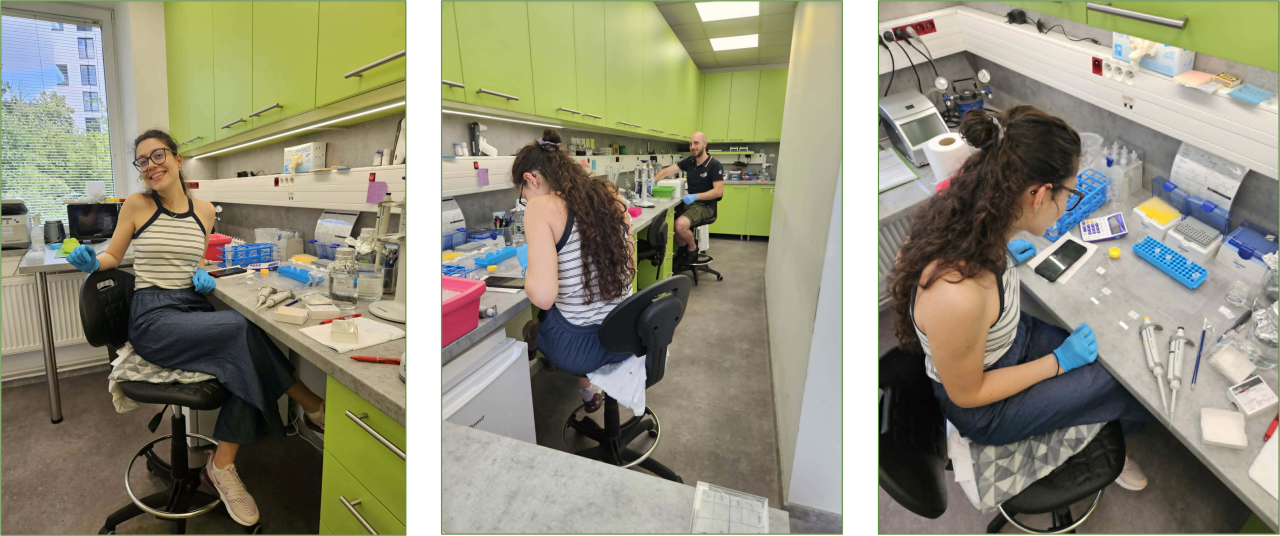
- What is your field of expertise? What are you currently working on?
My research focuses on the mechanisms of the replication stress response (RSR) in human cells and how defects in these pathways contribute to cancer. I am currently studying the protein RAD52 and investigating how changes in its expression influence the cellular response to DNA damage and replication stress.
- How did you choose this topic? What do you hope to achieve in the future?
I chose this topic because RAD52 is a fascinating and highly conserved protein. In yeast, it performs a role similar to that of BRCA2 in human cells, and in humans it plays a crucial role in the response to DNA damage and replication stress. Since RAD52 is frequently deregulated in cancer, I hope my research will contribute to demonstrating that it could become an attractive target for future anti-cancer therapies.
- What keeps you fascinated about your work?
What I enjoy most about research is that it is constantly evolving. Biology is unpredictable, and unexpected results are not necessarily failures—they often open the door to entirely new questions. That is what makes scientific research so exciting.
- Can you share your plans for your research stay at the Institute of Biophysics?
During my stay at IBP, I would like to broaden my expertise in quantitative image-based cytometry (QIBC). I was also fascinated by the laboratory's bioRxiv preprint describing automated DNA fiber assay analysis, which I found truly groundbreaking. I am excited to learn more about this methodology and explore how it can complement my own research.
- How do you maintain your work–life balance? What do you enjoy doing when you are not in the lab?
Outside the laboratory, I enjoy staying active through sports. I regularly go to the gym, which helps me relax, especially after challenging days in the lab. I also love figure skating, surfing, and skiing. On weekends, I volunteer by organizing activities for a youth group, which is another important part of my life.
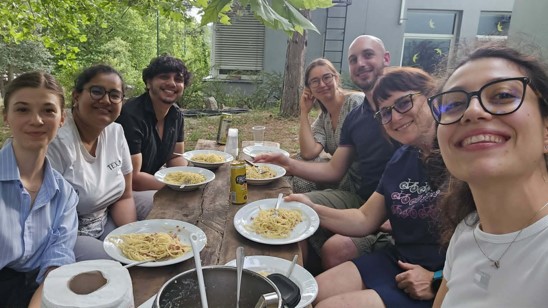
Italian dinner with lab members.